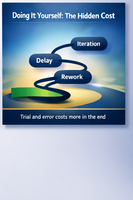
It usually starts with a reasonable idea. “Let’s try to handle this ourselves first.” You’ve done...
When Customers talk about choosing Professionals, they often describe the decision as a matter of instinct.
“I had a good feeling about them.”
“They seemed confident.”
“We clicked in the first meeting.”
Gut feeling plays a role in many business decisions. It helps Customers assess tone, communication style, and personal fit. But when it comes to Professional services, relying on instinct alone introduces unnecessary risk.
This article explains why gut feeling is unreliable as a primary decision tool—and how combining judgment with data leads to better outcomes when hiring Professionals.
.png?width=1024&height=1024&name=Designer%20(2).png)
Why Gut Feeling Is the Default for Choosing Professionals
For many Customers, hiring Professionals feels different from buying products or software. The work is intangible, outcomes are delayed, and quality is hard to assess upfront.
In that uncertainty, instinct becomes a shortcut.
Gut feeling is often shaped by:
- how confident a Professional sounds,
- how quickly they respond,
- how well they explain their approach,
- whether they “feel experienced.”
These signals are not useless. Communication matters in Professional services. But instinct tends to overweight presentation and underweight delivery.
Confidence is easy to display. Consistent performance is harder to see without evidence.
The Problem with Relying on Gut Feeling Alone
The main weakness of gut feeling is not that it is wrong—it is that it is unverifiable.
If a decision works out well, instinct feels validated. If it goes badly, there is no clear way to understand why.
Gut‑based decisions suffer from three predictable problems.
First, bias. People naturally favour confidence, familiarity, and similarity. These traits do not reliably correlate with quality delivery.
Second, inconsistency. Different decision‑makers can assess the same Professional very differently based on personal preferences rather than performance.
Third, lack of accountability. When a decision is based on instinct, it is difficult to explain or defend internally if outcomes fall short.
In Professional services, where engagements affect cash flow, compliance, and reputation, this lack of structure increases risk.
What Data Adds to the Decision Process
Data does not replace judgment. It strengthens it.
When Customers use data in choosing Professionals, they gain access to information that intuition cannot reliably detect.
Relevant data includes:
- how often a Professional completes work on time,
- how consistently scope is delivered as agreed,
- how multiple Customers rate quality and value,
- how performance compares across similar engagements.
This type of information reveals patterns. Patterns are more predictive than first impressions.
A single meeting shows how someone presents. Data shows how they actually perform.
Why Data Matters More as Complexity Increases
The more complex the engagement, the less reliable gut feeling becomes.
For simple, low‑risk tasks, instinct may be sufficient. But as soon as scope expands, timelines matter, or compliance is involved, consequences compound.
In these cases, Customers are not choosing personality. They are choosing:
- execution discipline,
- communication under pressure,
- ability to manage ambiguity,
- willingness to resolve issues constructively.
These traits are best assessed through past behaviour—not intuition.
Data allows Customers to see how Professionals behave when things do not go perfectly, which is when quality truly matters.
Combining Judgment and Data for Better Outcomes
Smarter decisions do not eliminate gut feeling. They put it in the right place.
A practical approach for Customers is:
- Use data to narrow options to Professionals with proven, consistent performance.
- Use judgment to assess fit, communication style, and expectations within that shortlist.
This sequence matters.
When instinct comes first, it can override evidence. When data comes first, instinct becomes a refinement tool rather than a gamble.
The result is a decision that feels right and stands up to scrutiny.
How Pasar Jasa Supports Data‑Driven Selection of Professionals
Pasar Jasa is built to help Customers move beyond instinct‑only decisions without making the process complex.
The platform does this by embedding:
- Verified reviews linked to completed transactions,
- Structured feedback on quality, timing, and value,
- Comparable service listings that reduce ambiguity,
- Clear scope and pricing defined before engagement.
These features allow Customers to see patterns across many engagements, not just polished introductions.
Gut feeling still plays a role—but it is supported by evidence rather than guesswork.
A Practical Takeaway for Customers
Before hiring Professionals, ask yourself:
- What evidence supports my initial impression?
- How has this Professional performed across similar engagements?
- Am I reacting to confidence—or to consistent outcomes?
Good decisions feel comfortable. Great decisions remain sound even when challenged.
When Customers combine judgment with data, they reduce risk, improve outcomes, and turn hiring Professionals from an anxious guess into a disciplined business process.
Check out our guide to hiring a Professional here.

.png?height=200&name=Designer%20(5).png)