When growing businesses think about professional services, firms are often seen as the “safe” or...
It’s all in English.
The meeting is conducted in English.
The emails are in English.
The proposal is written in English.
So everything should be clear… right?
Not always.
Because in cross-border business, language is shared - but meaning isn’t always aligned.
You walk away thinking:
- “We’re aligned on scope.”
- “The timeline is realistic.”
- “They understand what we need.”
But a few weeks later, the outputs don’t match expectations.
Not because anyone was trying to mislead you.
But because the same words were interpreted differently.
That gap - between what was said and what was understood - is one of the most underestimated risks in doing business in Indonesia.
And it’s exactly where the right Professional adds real value.
Speaking the same language doesn’t guarantee alignment
Foreign founders often assume:
“If we’re working in English, we’re working with shared understanding.”
That assumption works in environments where:
- definitions are standardised
- expectations are explicit
- and communication is direct
But in Indonesia, even when English is used fluently:
- terminology may be interpreted differently
- assumptions may not be surfaced
- and important nuances can be lost in translation
So the real issue isn’t language fluency.
It’s meaning precision.
Where linguistic gaps show up in practice
These gaps are subtle - but they have real consequences.
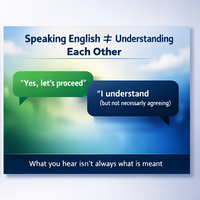
1) “Understood” doesn’t mean the same thing
When someone says:
- “Yes, understood”
It may mean:
- “I hear what you’re saying”
- not necessarily
- “I fully understand the implications and next steps”
2) “We can do it” doesn’t confirm feasibility
Statements like:
- “We can do this”
May reflect:
- willingness
- intent
- or optimism
…rather than a fully validated execution plan.
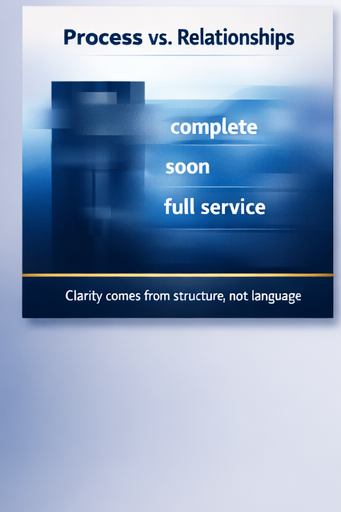
3) Scope sounds aligned—but isn’t
Words like:
- “complete”
- “standard”
- “full service”
Can be interpreted differently depending on:
- industry norms
- prior experience
- or internal assumptions
Without clarification, both sides think they agree - until delivery.
4) Timing expectations diverge
Phrases like:
- “soon”
- “in progress”
- “almost done”
Sound clear.
But they don’t always map to:
- specific timelines
- defined milestones
- or delivery commitments
Why this becomes a real business risk
Linguistic gaps don’t usually create immediate conflict.
They create misalignment that only becomes visible later.
That leads to:
- Rework → because output doesn’t match expectations
- Delays → because clarification happens too late
- Frustration → because both sides feel they were “clear”
- Disputes → because agreements weren’t as precise as assumed
This isn’t about one big mistake. It’s about small misunderstandings that compound over time.
What a good Professional does differently
This is where an experienced Professional changes the equation.
Not by speaking better English.
But by forcing clarity where language allows ambiguity.
1) They define terms clearly
Instead of relying on general language, they specify:
- what “complete” means
- what’s included
- what’s excluded
- what success looks like
2) They translate intent into structure
They take vague input and convert it into:
- defined scope
- clear deliverables
- measurable outputs
- documented expectations
This removes guesswork.
3) They eliminate ambiguity early
A good Professional will ask questions like:
- “What exactly do you need included?”
- “What is the expected output format?”
- “What is the deadline tied to?”
Not to slow things down - but to avoid rework later.
4) They document alignment
Crucially, they don’t rely on verbal confirmation.
They:
- summarise agreements
- confirm assumptions
- document scope
- create a reference point for delivery
This turns assumed understanding → into actual alignment
Common hiring mistakes foreign founders make
Linguistic gaps amplify a few predictable mistakes.
Mistake 1: assuming clarity because the conversation felt smooth
Smooth communication ≠ shared understanding.
Clarity needs to be tested - not assumed.
Mistake 2: relying on general language instead of specifics
Words like:
- “full support”
- “end-to-end”
- “comprehensive”
…sound convincing, but can hide major gaps.
Mistake 3: not confirming assumptions in writing
If expectations aren’t documented clearly:
- they will be interpreted
- not followed precisely
A simple checklist for choosing the right Professional
When evaluating Professional services in Indonesia, prioritise precision over fluency.
Look for Professionals who:
- define scope in detail
- break work into clear deliverables
- clarify assumptions proactively
- use written summaries consistently
- reduce ambiguous language
If everything sounds “smooth” but nothing is clearly defined, that’s a warning sign.
Where Pasar Jasa fits
Linguistic gaps become far less risky when engagement is structured.
Pasar Jasa reduces ambiguity by:
- requiring clear scope and deliverables
- linking work to defined milestones
- structuring communication around documented agreements
- tying reviews to actual completed outcomes
This doesn’t eliminate linguistic differences.
But it ensures that:
what is agreed is clearly defined - and measurable.
Closing thought: precision is a competitive advantage
Doing business in Indonesia doesn’t require perfect language.
It requires clear meaning.
The right Professional helps you:
- turn conversations into structure
- turn assumptions into clarity
- turn intent into execution
Because in cross-border work:
it’s not what was said that matters.
it’s what was understood - and delivered.
Want to reduce risk when engaging Professional services in Indonesia? Explore verified Professionals on Pasar Jasa and work with people who bring clarity, structure, and precision to every engagement.